The Scandal in Brief
On Sunday, Nov. 8, Nvidia’s board announced an independent investigation into the relationship between CEO Jensen Huang and a woman U.S. intelligence officials reportedly believe may be a Chinese spy. {10} China’s Foreign Ministry dismissed the claims as a smear campaign. The story widened midweek when the New York Times reported that Huang also had a relationship with Kimberly Powell, an Nvidia vice president. On Thursday Huang resigned, CFO Colette Kress became interim CEO, and Harvey Jones was named the company’s first board chair. {6}
The board has said it has no reason to believe national security or company information was compromised {10}, and reports about espionage and Chinese shipments remain allegations under scrutiny, not established findings. {11}
What the Stock has Done
Nvidia closed at $186.64 on Friday, Nov. 6. The week since:
Monday: -4.3% {1}
Tuesday: -5.47% {1}
Wednesday: +2.87% {2}
Thursday: -4.3% to $166.19, after falling as much as 14.3% intraday {3}
Friday: -2.01%, closing below a $4 trillion market cap for the first time since July 2025 {4}
By my arithmetic that puts the shares near $163, about 13% below the pre-scandal close. The slide predates the scandal: by Nov. 10 the stock was already 30.4% below its Oct. 6 record close. {12}
The damage looks company-specific. On Nov. 9, AMD rose about 9.4%, Broadcom 7.5% and Marvell 8.7% while Nvidia fell. {9}
Analysts are split. HSBC downgraded Nvidia to Hold, expecting the stock to languish until a permanent CEO is named, and TD Cowen dropped it as a top pick. {8} Dan Ives put fair value at $225 a share without Huang vs. $300 with him. Even so, the average 12-month analyst target is still about $327. {13}
Setting up the math
Fundamentals haven’t changed yet. Nvidia reported on Tuesday, Nov. 17, with a 5 p.m. ET call {14}, and third-party estimates call for EPS near $2.47 on roughly $109 billion in revenue. {15} This was the first report under the new leadership.
I used two standard tools.
1. Lognormal volatility ranges. This week’s five daily moves had a standard deviation of 3.3%, or about 53% annualized. That’s a small sample, so I bracketed 45%, 60%, and 80%. At 60% volatility from about $163, the one-standard-deviation range is $137-$194 over 1 month and $121-$220 over 3 months.
2. A Monte Carlo simulation. I ran 200,000 price paths over 63 trading days with a leadership-stock jump on the earnings reaction. The paths mix three regimes, with probabilities I assigned. This mirrors Bank of America’s framing of a contained scenario versus prolonged uncertainty before earnings.
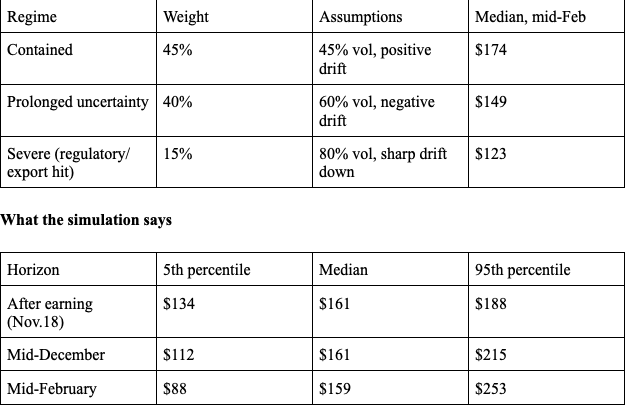
Other model outputs by mid-February:
29% chance of closing above the pre-scandal $186.64
11% chance of closing above Ives’s $225 “no Huang” value
34% chance of closing below $140
19% chance of closing below $120
43% chance of touching below $130 at some point
The median stays near $160 because the optimistic and pessimistic regimes offset each other. The real finding is the width of the range. For earnings, options have historically implied a move of roughly 5.6%, against an average of about 7.6% over twelve quarters. {16} The model’s earnings-day range is wider because it also prices in the leadership shock.
Caveats
These models are simpler than the market. Geometric Brownian motion assumes constant volatility and no fat tails, and real stocks gap. The regime weights are my judgement, and nothing in the data pins them down. One analyst expects the scandal could weigh on the stock for 3-6 months. The bull case has real support, though: Robinhood traders bought roughly twice as much Nvidia on Thursday as the rest of the stocks traded, combined. The key variables are the earnings guidance, the board’s findings and, above all, who becomes the permanent CEO.
This is analysis for discussion, not financial advice.