The Strait of Hormuz Deal is Signed: It’s Already Being Tested
On June 14, 2026, the United States and Iran announced an initial agreement to end roughly three months of war and reopen the Strait of Hormuz, one of the world's most important shipping routes.{¹} Since then, the deal has been signed, partially honored, declared dead, and patched back together on the way to a final agreement. Oil is moving through the strait again, but not at the fullest capacity, and definitely not without threats flying in both directions.
Here’s where things actually stand, and why the next 60 days are so important.
The war began on February 28, 2026, when the US and Israel launched strikes on Iran. Iran then retaliated by effectively closing the Strait of Hormuz, curbing oil exports to the rest of the world.{²} The International Energy Agency has called the resulting shock the largest supply disruption in the history of the global oil market.{³} A first ceasefire in April collapsed within weeks, and nothing materialized until June 17th.
On June 17th, the United States and Iran signed a 14-point memorandum of understanding (MOU), laying out specific terms for future peace. The deal extends the ceasefire 60 days to negotiate a final deal, plans for the reopening of the strait and the lifting of sanctions on Iran, and calls for an end to all military operations in the region, including a stop to Israel-Hezbollah fighting in Lebanon. It also includes a $300 billion plan for the reconstruction and development of Iran – a testament to the damage done to Iran in this conflict.{⁴}
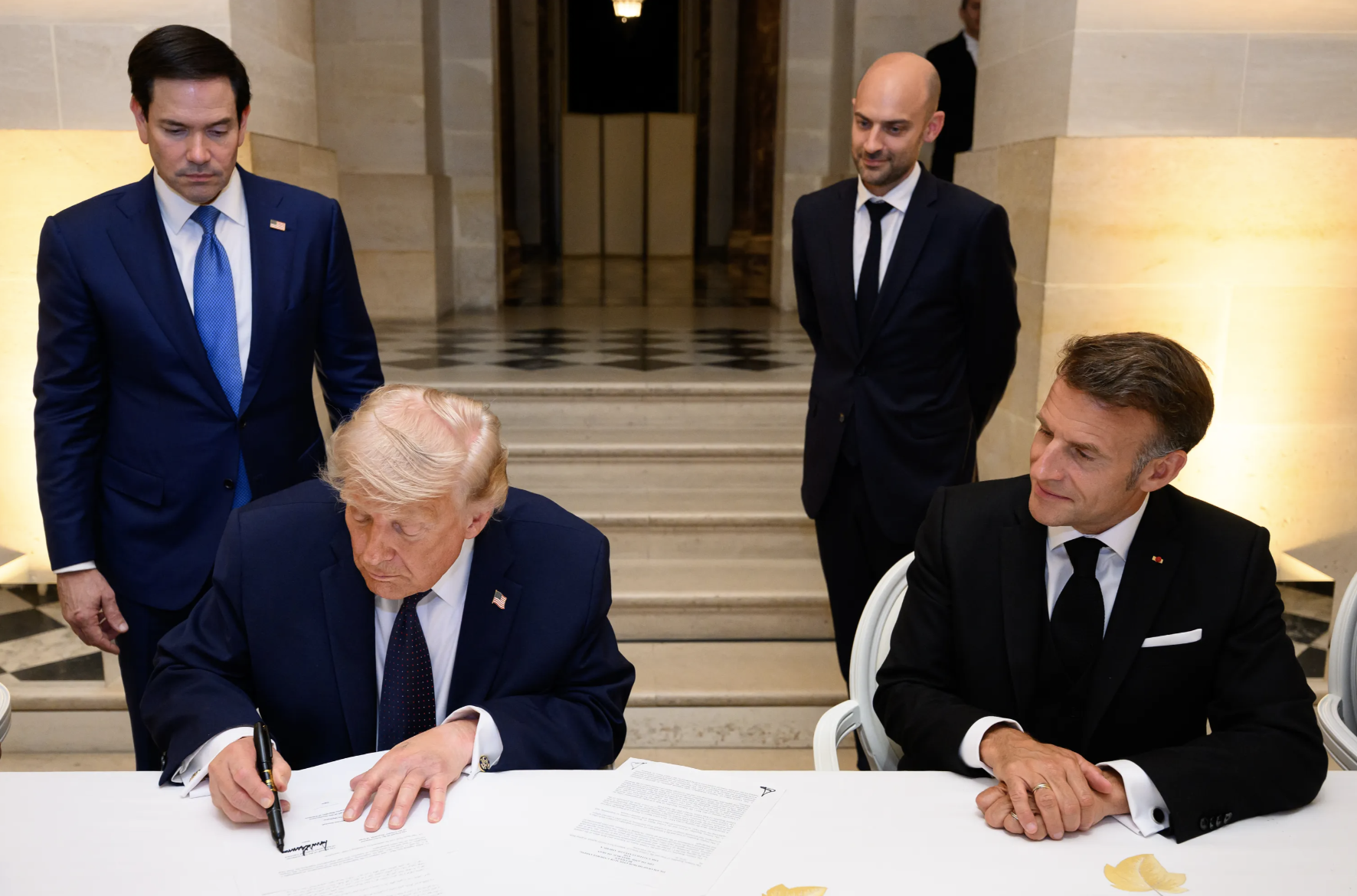
President Donald Trump signing the MOU in Versailles, France, at the G7 Summit. Beside him is French President Emmanuel Macron.
The MOU provides a framework for further peace; however, it does not establish peace right away. It gives an outline that is then up to further negotiations between the involved parties. Although the signing didn’t immediately settle anything, shipping traffic did pick up, with around 12.5 million barrels of oil moving through the strait Wednesday night, the highest volume since the war started.{⁵} US Vice President JD Vance met with Iran, Qatar, and Pakistan in Switzerland over the weekend to discuss further proceedings.{⁶}
However, on June 20th, Iran’s military announced it had closed the strait again due to continued Israeli strikes on Lebanon, with Iran blaming the US for not enforcing the ceasefire in Lebanon. President Donald Trump then threatened on social media to “hit Iran very hard again,” and Iran announced that it would be ready to respond.{⁷} The current situation regarding the closure of the strait remains very fragile.
Fighting in Lebanon briefly escalated. Israeli strikes killed at least 16 people, including civilians, on June 20th. Israel claimed they were responding to Hezbollah fire; Hezbollah said they were responding to Israeli movement into Lebanese territory.{⁸}
Talks were held in Switzerland despite the ongoing tensions. On Monday, June 22nd, Qatar and Pakistan announced that the United States and Iran had agreed to a roadmap for a final deal within 60 days and a direct communication line meant to avoid future incidents. Both sides agreed to establish a committee to address nuclear monitoring and sanctions. They also agreed to a framework for ending military operations in Lebanon.{⁹}
Iran’s foreign minister said exports of oil and petrol have been cleared, the blockade lifted, and some frozen assets released, calling the Lebanon proceedings the first real test of the negotiations.{¹⁰} There was a notable sign of progress on the ground in Lebanon: for the first time since the conflict between Hezbollah and Israel started in March, the UN peacekeeping force in Lebanon reported zero attacks from either side on Sunday.{¹¹}
The two areas that remain the most unsettled are Iran’s nuclear capabilities and the situation in Lebanon. Iran’s President Masoud Pezeshkian said Iran will not give up its right to enrich uranium, while the US has continued to push for the program’s elimination.{¹²} US Vice President JD Vance announced at the Switzerland Summit that Iran agreed to IAEA nuclear inspections; however, Iranian officials have said they have made no new nuclear concessions and have disputed aspects of the US description of the negotiations.{¹³} The scope of any nuclear negotiations remain unclear.
As for Lebanon, Israel hasn’t signed the MOU and has made it clear it won’t fully withdraw from Lebanese territory. Israeli Prime Minister Benjamin Netanyahu said this weekend that Israel will keep a “security zone” in Southern Lebanon until Hezbollah is fully disarmed.{¹⁴} Iran has made it clear that an end to all Israeli military operations in Lebanon is a necessary condition of a long-lasting peace deal.
Only time will tell what happens next; however, the war has already left a huge mark in economic and death terms. Moody’s Analytics estimates that the conflict has already cost American consumers around $132 billion, driven mostly by gasoline prices that spiked from just under $3 per gallon before the war to a peak of $4.56 per gallon.{¹⁵} The Pentagon estimated that operational costs reached $29 billion as of mid-May, excluding damage done to US military bases in the region.{¹⁶}
Globally, the World Bank cut its 2026 economic growth forecast to 2.5%, the lowest since the pandemic, and projected Gulf economies’ combined GDP growth would fall to 1.3% this year from 4.5% in 2025. Middle East oil producers cut oil output by more than 11 million barrels a day in May compared to pre-war levels, heavily affecting the economies for the Gulf states.{¹⁷,¹⁹}
Beyond the economic impact of the war, the human toll has been steep. 13 US service members have been killed, more than 3,400 Iranians according to state media, more than 4,000 in Lebanon, and 60 in Israel.{¹⁸}
The next 60 days will determine whether this deal becomes a lasting peace or another extended pause. The main areas to be negotiated will be Iran’s nuclear capabilities, sanctions, the Strait of Hormuz, and military activity in Lebanon. Watch for whether shipping through the strait stabilizes or keeps stopping and starting with each new flare-up in Lebanon and whether Iran’s or the US’s position on enriched uranium moves at all. Domestic political considerations may also influence the negotiations, as the administration faces congressional midterm elections in November. A stable and favorable outcome could become a significant part of the administration’s foreign policy record heading into the election.
There is still considerable uncertainty about the future relationship between the US and Iran. The signed memorandum of understanding does not put anything long-lasting into action – it provides time for a long-lasting deal to be made. For now, oil is flowing, mostly. Whether that holds depends on the negotiations that are just getting underway.
