The Data Center Boom Just Hit a Wall
On July 14, 2026, New York Governor Kathy Hochul signed an executive order making her state the first state in the country to impose a state-level moratorium on new large data centers. The restriction lasts up to a year. {¹} But what actually is a data center, what does it take to build one, and what are the consequences of building one?
What a Data Center Actually Is
A data center is a building full of servers and computers that store data, run applications, and power everything from a Google search engine to an AI chatbot. When people talk about “the cloud,” they are referring to a data center. {²} Every text message or email sent, video streamed, or AI response is processed and stored on physical servers and machines in a data center. Data centers are not new to the AI boom; however, the extent and size to which they are being built are.
Data centers have been getting a lot of attention recently because of the “hyperscale” data centers that artificial intelligence applications require. Amazon, Microsoft, Google, and Meta are just some of the companies that have developed “hyperscale” data center campuses. To put in perspective how much electricity these hyperscale data centers use, a single hyperscale facility can use as much electricity as several hundred thousand homes. This is largely due to two things: powering the servers and running the cooling systems needed to keep the servers from overheating. Hyperscale data centers require much more electricity than existing data centers because AI workloads, which include training and running large models, require far more computing than a typical email or streaming server. {³}
A big risk that accompanies these data centers is the strain on the power grid. The existing US power grid lacks the capacity to power all the data centers required by the AI influx. The high levels of power required to service AI infrastructure could also spur a search for alternative power sources, such as nuclear energy. {⁴}
What They Use
Three resources dominate the data center conversation: electricity, water, and land.
As mentioned before, electricity is the biggest constraint. Data centers often need hundreds of megawatts of continuous power, 24/7. The amount of power is so significant that developers have to negotiate directly with utilities and regional grid operators years in advance. Another resource the centers use is water. Most facilities use water in their liquid cooling systems, drawing from local water supplies and then discharging wastewater. On top of that, data centers need large plots of land on which to be built. Data centers are large industrial-scale buildings spanning hundreds of acres. Oftentimes, communities near proposed build sites push back over noise, traffic, waste, or zoning. {⁵}
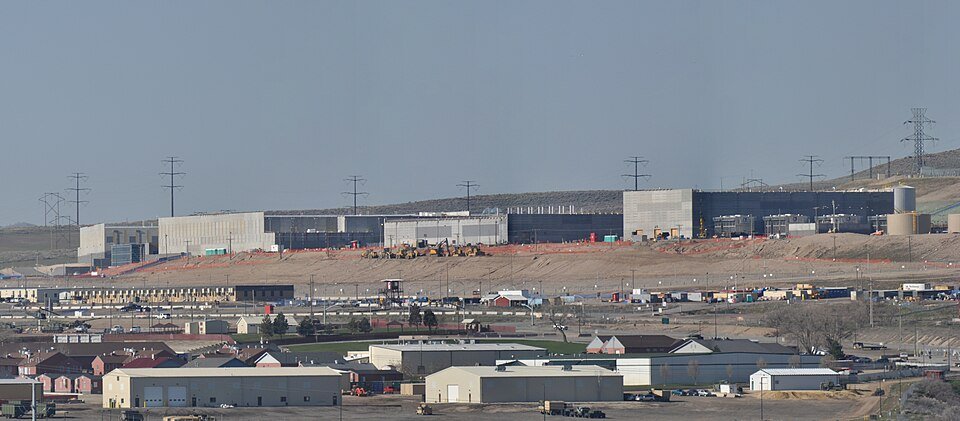
Data Center Located in Bluffdale, Utah
Photo: Wikimedia Commons
The Approval Process
For a data center to be built, there isn’t a single approval, but rather roughly a half dozen separate processes running at the same time, each overseen by a different authority.
Local zoning boards decide whether a data center is an allowed use on a given piece of land. Many projects require a public hearing before local officials.
State environmental agencies (such as the New York Department of Environmental Conservation) issue permits covering air quality, water withdrawal and discharge, and broader environmental impacts. {¹¹}
Utilities and regional grid operators conduct interconnection studies to determine whether the local electric grid can handle the new demand and what upgrades are needed. This step can take years for the largest projects because it requires analyzing effects on grid reliability and stability across an entire region, then making the necessary upgrades.
The Federal Energy Regulatory Commission (FERC) would get involved when a project affects the interstate transmission grid. Most of the time, the day-to-day siting authority for power generation rests with the states.
Local building departments handle structural, fire, and life-safety permits before construction can begin.
Because these processes run concurrently rather than sequentially, a delay in one can stall a project even after every other approval is secured. The area where data centers are being built matters a lot. In fast-moving markets like Texas, some of these steps can be resolved in weeks; however, in congested grid regions like Northern Virginia, interconnection queues alone can stretch for years. {⁶}
What New York’s Moratorium Actually Does
Gov. Hochul’s order doesn’t touch zoning or building permits. Those remain with local governments. What it pauses is the state’s discretionary environmental permitting for new hyperscale facilities that use 50+ megawatts of power for up to a year. During that time, the state will establish consistent standards for evaluating a project’s energy demand, water use, and air-quality impacts and will issue guidance to local governments on negotiating community benefits (such as infrastructure upgrades and direct payments) with developers. It is important to note that states don’t want to ban data center development indefinitely because data centers can offer economic benefits to the state through taxes, jobs, and business spillovers.
The executive order is separate from a bill New York state lawmakers passed in June, the Responsible Data Center Development Act, which would set its own one-year moratorium at a lower 20+ megawatt threshold. Hochul hasn’t signed or vetoed that bill, stating that she is still negotiating details with the legislature.
Although this order is only effective in New York, it sets a model for other states to follow. New York is the first state to impose such a state-wide moratorium, but keep an eye out for states that follow. {¹}
The Arguments on Each Side
Supporters of the executive order, including environmental groups and some state lawmakers, point to New York’s residential electricity prices, which have risen sharply since 2019, and argue that a pause gives the state time to write rules that protect residents and water supplies before more large facilities are approved. {⁷} A statewide poll in June found that many New Yorkers supported a one-year moratorium, with backing from both political parties. {⁸}
Industry groups, including Tech:NYC, which represents companies like Google and Amazon, have argued that a full year is too long and risks pushing investment and jobs to other states. {⁹} The tension isn’t unique to New York. Maine’s governor vetoed a similar moratorium bill this year over concerns it would block a project Maine was counting on, while Arizona took a narrower approach, ending sales and tax breaks for new data centers rather than pausing construction outright. {¹⁰}
What Comes Next
New York’s pause is temporary on purpose. Its outcome will depend on what regulatory framework the state adopts before the year is up, as well as whether Gov. Hochul signs the legislature’s separate, broader bill. New York is pioneering data center regulation for other states to watch closely. Moratorium proposals have surfaced in roughly a dozen state legislatures this year, and New York’s experience is likely to shape how many of them proceed.
